Project Name:
Crossing fee
Client / Organization:
Magen Financial
Timeline:
2024 – 2026
Project Status:
Production Live | Actively Maintained
Project Overview
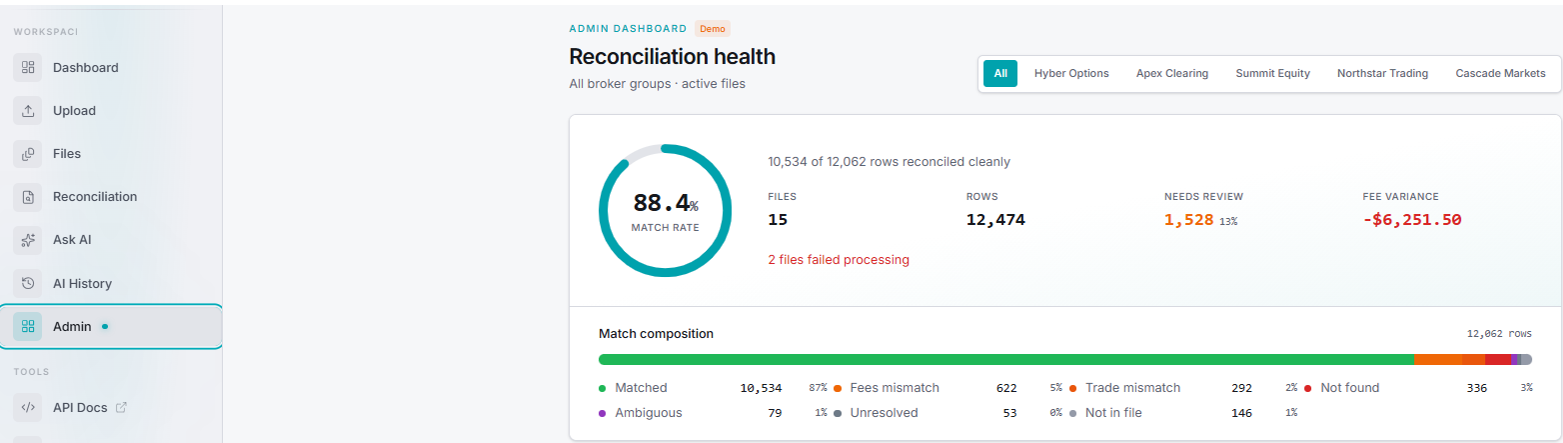
Crossing Fee Reconciliation Platform is an enterprise-grade reconciliation platform developed for equity and derivatives trading operations. The platform automates broker crossing-fee reconciliation by ingesting multiple broker files, normalizing trading data, matching invoice records against internal trade data, and identifying reconciliation discrepancies such as incorrect fees, missing trades, billing errors, and unmatched transactions. AI-assisted recommendations and comprehensive audit tracking help operations teams resolve reconciliation exceptions efficiently while maintaining regulatory compliance and financial accuracy.
Designed around a scalable .NET and React architecture, the platform supports many-to-many trade matching, event-driven processing, intelligent reconciliation workflows, and secure enterprise integrations. By combining deterministic business rules withAI-assisted analysis, automated background processing, and centralized operational dashboards, the solution improves reconciliation accuracy, reduces manual effort, and streamlines high-volume financial operations.
Technology Stack
Frontend:
The frontend is built as a React 19 single-page application using TypeScript and Vite, providing a responsive user experience for reconciliation operations. It leverages TanStack Query for server-state management, AG Grid Enterprise for advanced data analysis, and Tailwind CSS,Radix UI components, and Recharts data visualization to deliver interactive operational dashboards, exception review screens, reporting, and email composition workflows. Shareable URL-based state, responsive layouts, and feature-based architecture streamline large-scale reconciliation processes.
Backend:
The backend is developed using .NET 8 with a layered application architecture combining ASP.NET Core MVC, Web API services, and Hangfire background processing. It manages the complete reconciliation workflow, including broker file ingestion, multi-format file parsing, trade matching, exception analysis, reconciliation, audit history tracking, and automated correction workflows. Event-driven processing, orchestration services, and broker-specific business rules enable high-volume transaction reconciliation across multiple broker formats.
Authentication & Security:
The platform implements secure authentication using Microsoft Entra ID, Microsoft.Identity.Web, and MSAL, ensuring authenticated access across the application. Row-level authorization restricts data visibility based on broker permissions and user roles, while Azure Key Vault securely manages application secrets. Comprehensive audit history, user attribution, and reversible reconciliation actions provide secure, traceable, and compliant financial operations.
AI Technologies:
The platform incorporates Semantic Kernel, Azure OpenAI, OpenAI GPT-4o, GPT-4o Mini, text-embedding-3-small, and Qdrant to provide intelligent reconciliation assistance. AI capabilities include retrieval-augmented rule matching (RAG), semantic search, automated exception analysi, AI-assisted reconciliation recommendations, structured SQL-based investigation, intelligent rule authoring, and operator-guided decision support. A deterministic-first approach ensures AI complements business rules while maintaining accuracy, auditability, and human oversight throughout the reconciliation process.
Database:
The application uses Azure SQL Database as its primary data platform, with multiple Entity Framework Core DbContexts managing transactional databases, application databases, read-only replicas, and Hangfire background processing. This architecture supports high-performance data access, scalable transaction processing, and reliable data isolation.
Third-Party Integrations:
The platform integrates with OpenAI, Qdrant Cloud, Azure Blob Storage, light">Azure Key Vault, SendGrid, Datadog, Azure Function Apps, and internal trading services. These integrations enable secure identity managementdocument processing, email delivery, application observability, and seamless communication with core trading systems.
Monitoring & Logging:
Application monitoring is implemented using Serilog and Datadog, providing structured logging, distributed tracing, request diagnostics, and centralized observability across the platform. An append-only audit history, read-only production replica, and business-level reconciliation tracking further support operational monitoring, troubleshooting, and compliance.
Testing:
The platform currently relies on a dry-run validation framework that executes real parsing and reconciliation logic against production-like data without persisting changes, supported by SQL verification procedures. While a dedicated automated test suite has not yet been implemented, the solution includes nullable reference types, ESLint validation, and type-checked production builds to maintain code quality and application reliability.
Deployment & DevOps:
Deployment and release management are automated using Azure DevOps Pipelines, with applications hosted on Azure App Service and integrated with Azure SQL Database, Azure Blob Storage, and Azure Key Vault. Continuous Integration builds a single deployable artifact that is promoted across environments through automated configuration management, ensuring reliable application deployments.
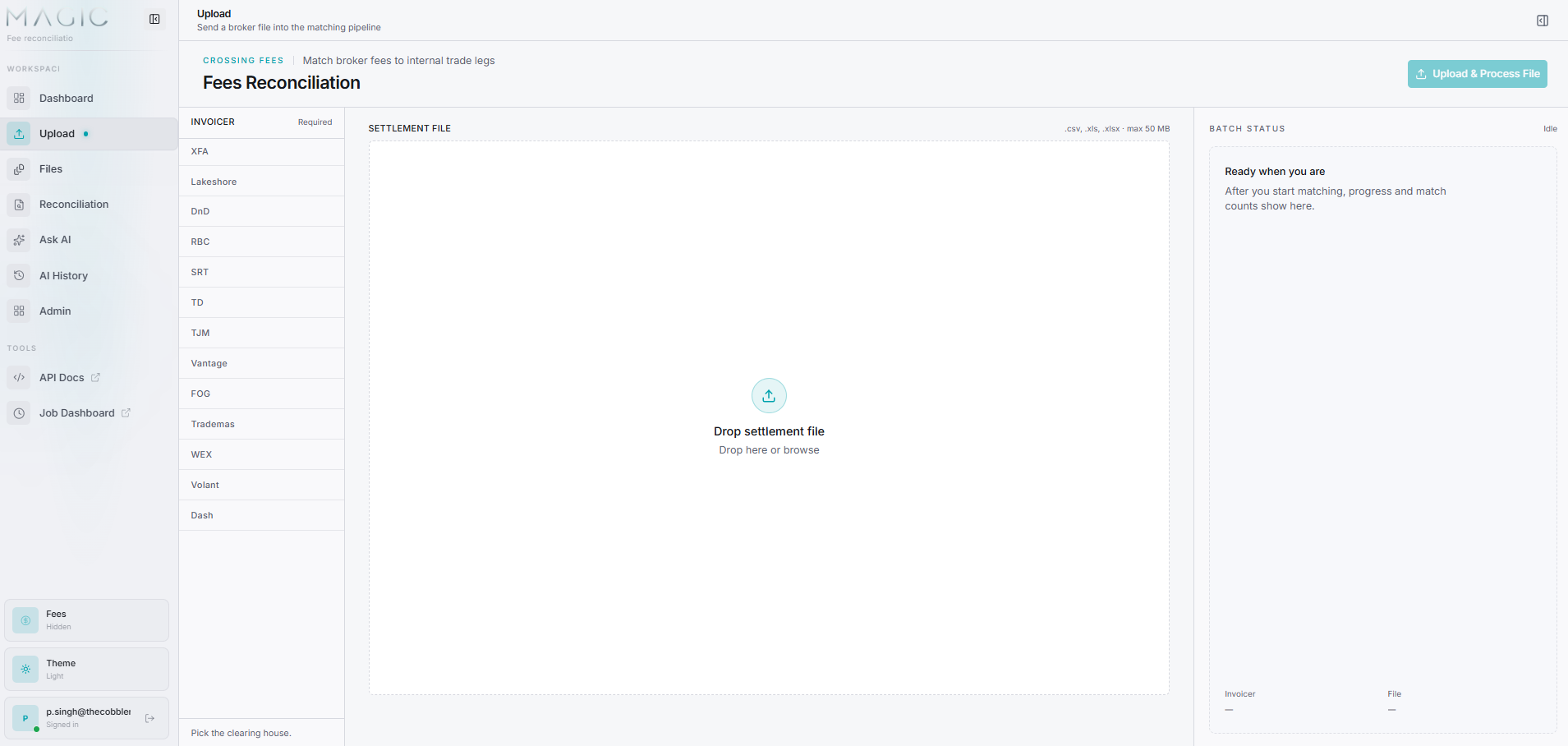
Reconcilition
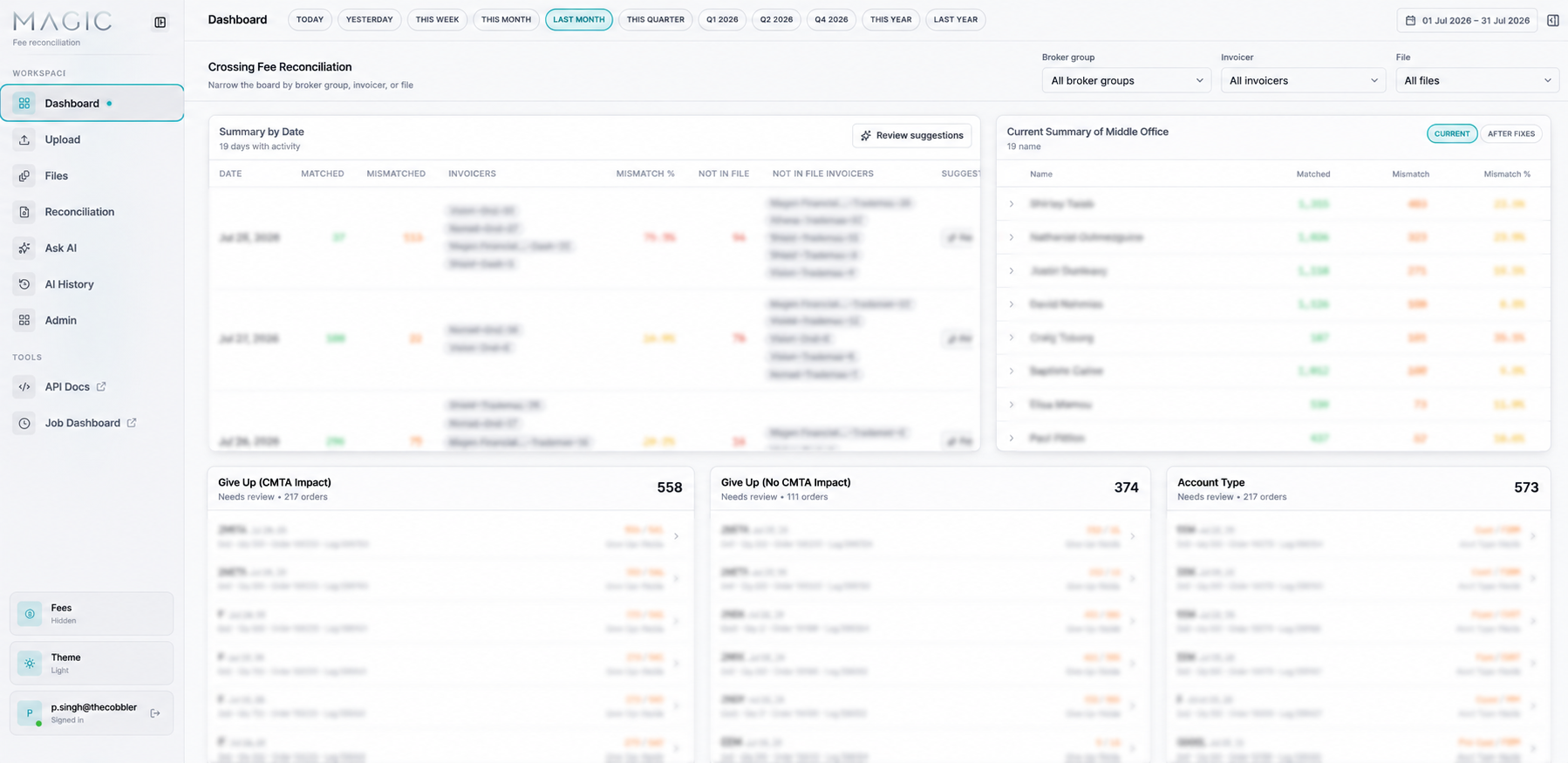
Crossing fee Reconcilition
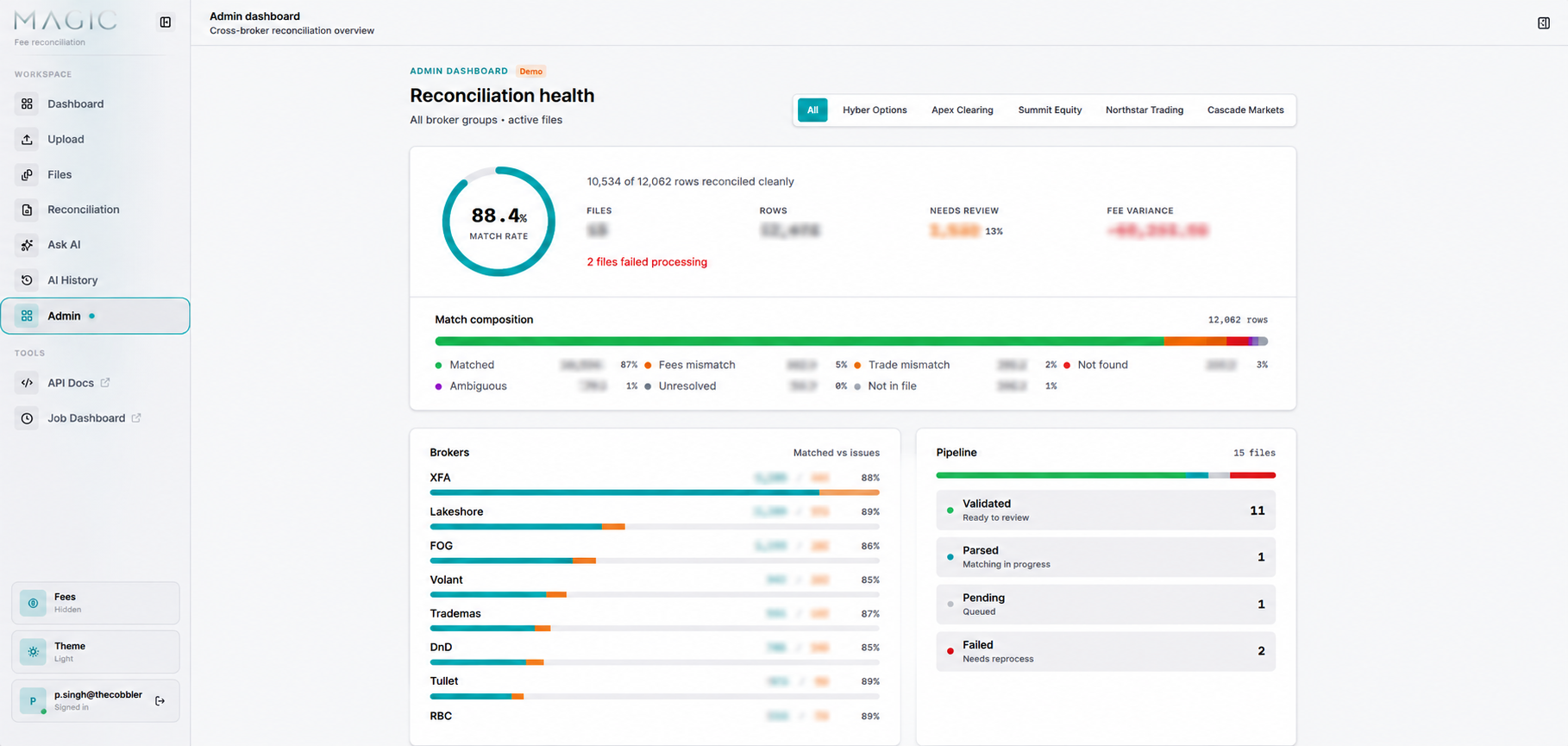
Reconcilition Health